Share:

Please enter a valid location
How to Reduce Reniform Nematodes and Protect Cotton Yield
Reniform nematodes in cotton can silently reduce yields while rapidly increasing populations in the soil. The right variety selection can help lower nematode pressure, protect yield potential, and even improve performance in the following soybean crop. Here’s what the latest data from a Mississippi State University trial shows — and how to control reniform nematodes.
Key Points
- Reniform nematode populations can increase up to 5x in one season.
- Cotton varieties with REN + RKN resistance can increase yield +175 to +502 lb/A.
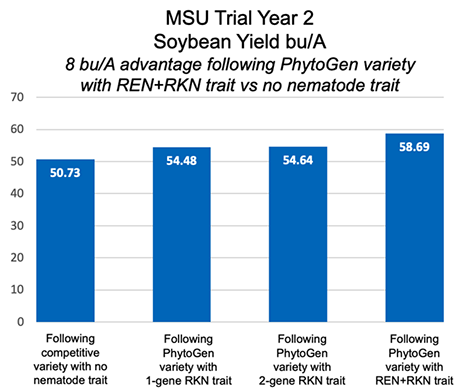
- Soybeans following REN + RKN resistant cotton yielded 8 bu/A more – or 16% greater.
- Company trials demonstrated, REN + RKN resistant cotton varieties showed a 73% reduction in REN populations vs. RKN-only varieties.
What University Trials Show in High-Reniform Fields
Field trials from Mississippi State University (MSU) show that PhytoGen brand varieties with both reniform (REN) and root-knot (RKN) resistance can increase yields by 175 to 502 lb/A in high-pressure fields compared to varieties without both nematode traits.

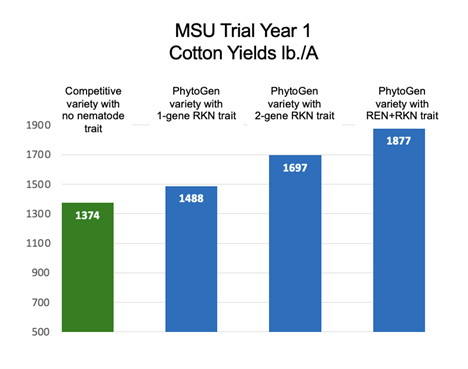
That’s just the beginning. MSU research demonstrates that effective REN and RKN management in a cotton-soybean rotation begins with planting a resistant cotton variety. That advantage can carry into the next crop. Soybeans that followed a PhytoGen brand variety with REN + RKN traits yielded 8 bu/A more — or 16% greater—than soybeans following cotton varieties without REN + RKN resistance. This highlights an opportunity for growers to increase yields in both crops by reducing overall nematode populations with PhytoGen brand varieties featuring REN+RKN traits.
Why Nematodes Cost You Yield (Even When You Don’t See Them)
Reniform nematodes are one of the most damaging — and often invisible—threats in cotton. They feed on plant roots, limiting water and nutrient uptake. The result? Slower growth, weaker plants, and yield loss that often goes unnoticed until it’s too late. Populations can increase rapidly in a single season, compounding pressure for future crops.

Nematodes don't just impact yield — they impact your bottom line:
- Reniform nematodes have the potential to cost growers more than $60 per acre in management expense and yield loss.1
- Root-knot nematodes can cost cotton producers another $60 to $70 per acre in most cotton states.1
While seed treatments and other chemical control measures provide short-term nematode suppression, a key component of an integrated pest management approach is choosing nematode-resistant varieties to deliver season-long root protection — helping drive stronger growth, higher yield potential, and reduce overall REN and RKN populations.
Are Reniform Nematodes the Missing Yield Threat in Soybeans?
In soybeans, the negative impact of root-knot nematodes and soybean cyst nematodes (SCN) is well known, but reniform nematodes are often overlooked — even though they can cause significant economic loss. Many soybean varieties offer native resistance to RKN and SCN, but there are currently no soybeans that offer REN resistance.
Growers, agronomists, and researchers have long questioned whether planting a nematode-resistant cotton variety can reduce REN and RKN populations — and ultimately improve soybean yield potential the following season. Recent research by Mississippi State University assistant research professor Tessie Wilkerson, Ph.D., from 2022 to 2024 helps answer that question.
What the MSU Study Found:
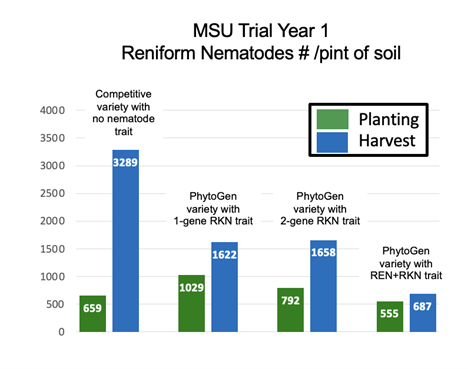
- REN populations increased 5x in one season with a non-resistant cotton variety.
- Planting a PhytoGen brand variety with REN + RKN resistance can significantly increase cotton yields in fields with threshold-level REN populations.
- In comparison, a competitive variety without nematode resistance saw much higher nematode levels.
- RKN-only varieties provided limited benefit against reniform, and populations doubled over the season.
The only cotton variety that reduced reniform populations in the MSU study was the PhytoGen brand variety with stacked REN + RKN traits.
End-of-Season Population Comparison
- REN populations for the competitive variety rose to 3,289 REN/pint of soil.
- REN populations for the PhytoGen brand variety were only 687 REN/pint of soil.
Soybean Impact the Following Season:
- After non-resistant cotton variety averaged 50.73 bu/A.
- After PhytoGen brand variety with REN + RKN resistance averaged 58.69 bu/A.
- That’s an 8 bu/A yield advantage.
Even more notably, 3 of the 8 soybean varieties yielded 10+ bu/A higher when planted behind the PhytoGen brand variety compared to the non-resistant option.
Why It Matters for Your Operation?
Lower REN populations at the end of a cotton season may help:
- Reduce pest pressure going into soybeans
- Protect yield potential in the following crop
- Improve long-term field productivity
Jonathan Siebert, Ph.D., agronomy lead for the South Delta and Southwest at Corteva Agriscience, says the MSU research confirms what he’s seen in trials and on farms across the Midsouth.
“Reniform nematodes are an often-overlooked pest that can negatively impact yield in both cotton and soybeans,” Siebert said.
“By planting PhytoGen brand varieties with reniform and root-knot nematode resistance, growers can reduce nematode populations in the field, increase cotton yields, and improve soybean production the following season.”
How PhytoGen Brand Varieties With RKN + REN Traits Reduce Pressure Across Seasons
Siebert said PhytoGen has seen similar results from company trials over a three-year period, across 35 locations in the Midsouth:
PhytoGen brand varieties with REN + RKN resistance had a 73% reduction in reniform populations compared to RKN-only varieties.
While Siebert believes an integrated pest management approach is always the best practice, he says the MSU research demonstrates that REN and RKN management in a cotton-soybean rotation begins with planting a resistant cotton variety.
“We’ve seen varieties like PHY 411 W3FE take off like wildfire in Mississippi, and a big part of that is the built-in reniform and root-knot resistance that’s increasing cotton yields and reducing nematode populations,” Siebert said. “If you have reniform nematodes and want to increase soybean yields, there’s no seed treatment or chemical control measure that will reduce field populations like planting reniform-resistant PhytoGen brand varieties the previous season. If you can increase soybean yields by 8 bu/A, you’re basically paying for your soybean seed. That's a game changer.”
Mississippi State University. “Managing Reniform Nematodes in Cotton-Soybean Rotations.” MSU Cotton Research Trials, 2023.
1 2022 Beltwide Cotton Conferences, Cotton Disease Loss Estimate Committee Report. Estimate assumes cotton price of $.65 per pound. ® Trademarks of Corteva Agriscience and its affiliated companies ©2026 Corteva.
AGRONOMY
Find information on nematode management and more in the PhytoGen Cottonseed Agronomy Library.